 |
| http://www.tigercolor.com/color-lab/color-theory/ color-theory-intro.htm#Color_Wheel |
Colour Wheel
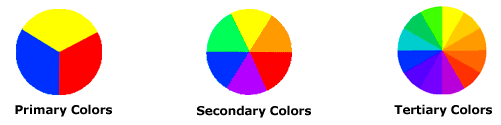 |
| http://www.colormatters.com/colo r-and-design/basic-color-theory |
 |
| http://www.tigercolor.com/color-lab/color -theory/color-theory-intro.htm#Color_Wheel |
There is also warm and cool colours, warm being the brighter more energetic colours, these are the reds, yellows, oranges, and the cool colours are the blues, greens and purples.
Colour Harmonies
Colour harmony is natures way of saying 2 or more colours go well
together. That are pleasing on the eyes.
Analogous Colours
Analogous colours are any three colours side by side on a 12 part colour
wheel.
Complementary Colours
Complementary colours are colours that are opposite each other on the
colour wheel.
Achromatic Colours
Neutrals, blacks and greys are all classed as achromatic colours.
Chromatic Colours
Chromatic colours are the actual colours you see.
Monochromatic Colours
Monochromatic colours are one shade of one colour.
Colour Context
How colours behave in relation to other shapes.
http://www.sensationalcolor.com/understanding-color/theory/color-relationships-creating-color-harmony-1849#.VHDVu_msWSo
http://www.colormatters.com/color-and-design/basic-color-theory

No comments:
Post a Comment